Chapter 1: Latency
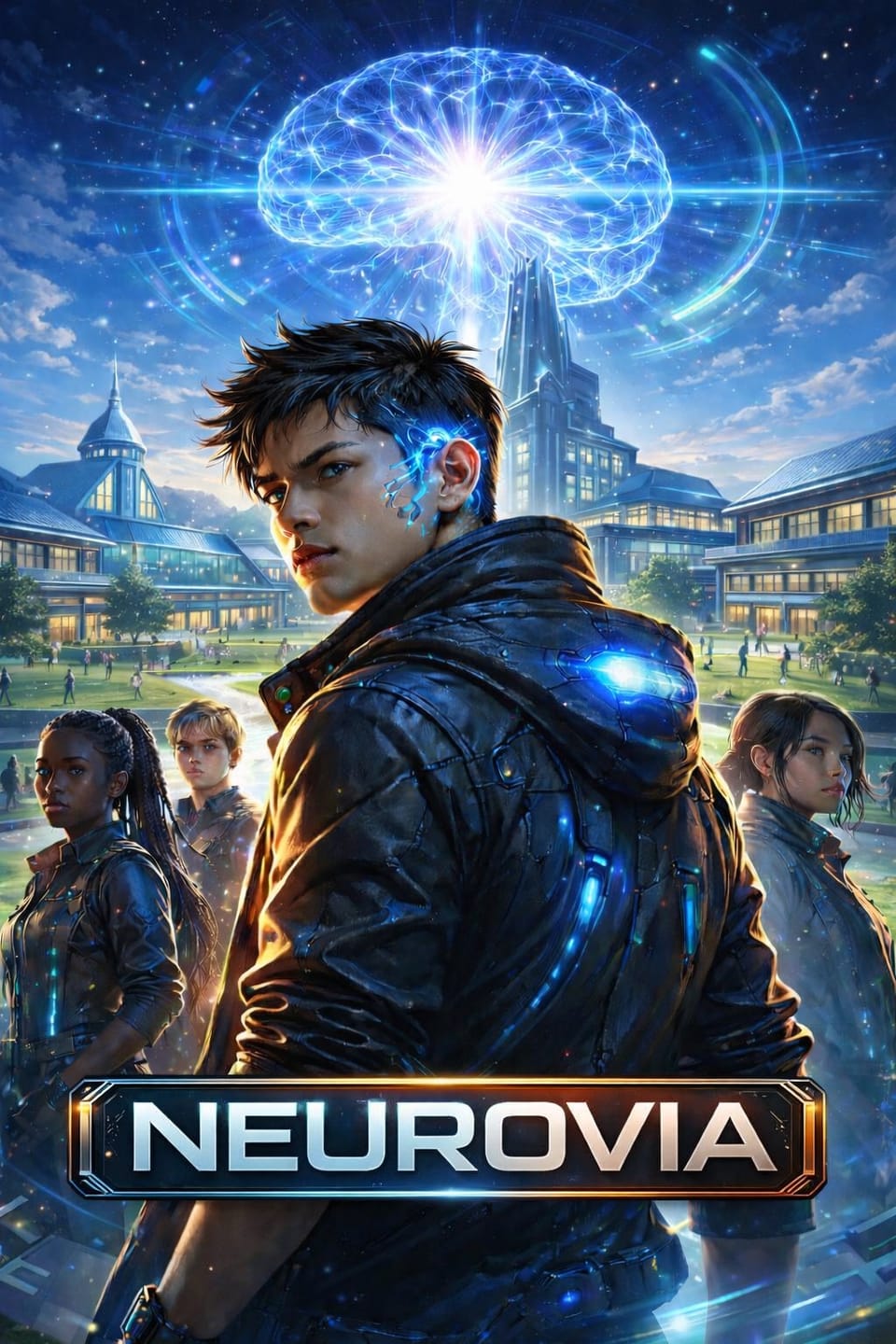
The escalator shuddered, and the AR didn’t.
Julian felt it as a tremor behind his eyes, the holographic safety rails splintering into drifting pixels before the system caught itself and stitched the image back together. Around him, commuters stood rigid on both sides of the moving staircase, bodies listing with the mechanical stutter. In the digital layer overlaid on his vision, the steps flowed downward in a seamless ribbon of light. In reality, the metal treads lurched.
Three steps ahead, a woman in a gray coat pitched forward. Her hand shot out to grab the railing, the one the Augmented Reality “AR” system showed her, the one that wasn't quite where her palm expected. She caught herself on the physical rail half a second later, knuckles white, breath audible even over the station's low hum.
Julian shifted his weight without thinking, the adjustment as natural as leaning into a corner on a bike. He wasn't startled. He was never startled anymore. Growing up bilingual had taught him that timing carried its own grammar: hesitate and you lose the meaning, rush and you miss the point. He had applied the same logic to the city's patchwork of real and rendered; learned to read the seams.
The elderly man beside him wasn't as practiced. His cane slipped sideways between the treads, and for one long heartbeat, the man's center of gravity abandoned him entirely. Julian's hand found his elbow before the man registered the fall. They rode down the last few steps like that, Julian's grip light but certain, while the man's AR glasses tumbled free anyway, clattering down the metal staircase in a bright, helpless arc.
A maintenance bot whirred from a hidden panel, its chrome pincer snatching the glasses with practiced precision before extending them upward, waiting.
"Strange," said the woman in gray, voice still unsteady. She was staring at the safety rail, her brow furrowed and lips slightly parted, right hand still hovering where the holographic image had been, left hand gripping the actual rail as if she couldn't quite decide which one was real. "I could have sworn it was right there."
Julian stepped off the escalator and turned toward her. "Lag."
She frowned. "Lag?"
"AR glitch." His voice was calm, the way you might name the weather. He watched her brow furrow further and added, "Happens more than they say."
She made a small, dissatisfied sound, adjusted her AR glasses as if that was the problem, and drifted into the flow of the crowd. Julian watched her go.
He stood a moment longer at the base of the escalator, looking back up at the ghost data still hovering in midair above the steps: a faint shimmer where pixels papered over the maintenance work the station hadn't gotten to yet. He had always been able to see the lag between what the system promised and what the world delivered. He had learned, young, that those two things were rarely the same.
His AR glasses pulsed. A translucent banner bloomed in the upper corner of his right eye:
JULIAN REYES — 1 NEW MESSAGE
Mamá: ¿Ya vienes? El tren.
He summoned the schedule overlay with a small flick of his gaze; soft blues and greens layering themselves over the station map like watercolor washes. Upstream delay alerts. A jitter in the platform signs where hurried code was hiding uncertainty behind confidence it hadn't earned. He felt the faint tremor underfoot: the rails telling him something the display boards hadn't caught up to yet.
Ten minutes.
He let the overlay dissolve.
Me: Sí. Diez minutos.
He moved toward the platform, hands loose in his jacket pockets. He knew his parents would be watching the clock at home the way people look out their window for their loved ones to come home. His father had been pouring concrete since before sunrise. His mother would still be moving between hospital rooms, counting the minutes between her shift's end and the next obligation waiting on the other side of it. For them, punctuality wasn't a virtue. It was math.
* * *
Three weeks later, at exactly 8:00 a.m., every screen in the apartment winked out.
Not a flicker. Not a gradual fade. A clean, coordinated silence; as if something had pressed a thumb down on the pulse of the room. The living-room wall display went dark mid-sentence, the morning anchor's mouth still open. The kitchen counter's recipe scroll froze on a half-finished tip about epazote. Even the small blue light on the router blinked off, then on, like a breath caught and released.
Then, in Julian's vision: the Neurovia Institute's cobalt-and-silver logo, blooming in the center of his field of view. Sharp. Immovable. Not asking permission.
His mother had been mid-pour, coffee tilted over a mug, the dark stream suspended in her attention as she registered the change. Julian..." Her voice caught on the first syllable, the 'J' stretching into a whisper, the 'n' almost disappearing at the end. She gripped the coffee pot with both hands, her knuckles whitening against the handle.
His father lowered his mug to the table like a man disarming a bomb, his eyes never leaving the glowing logo. His eyes tracked to the wall display, where the same logo had replaced the news. His jaw was still.
The message expanded in Julian's vision:
CONGRATULATIONS.
You have been selected for Cohort 2 of the Neurovia Institute. Enrollment includes eligibility for participation in the Catalyst™ Adolescent Integration Trial, pending guardian consent.
The word landed in his chest like a stone dropped into still water. He felt the ripples before he understood their shape.
"¡Dios mío." His mother pressed trembling fingers to her lips. Not a question. A prayer.
His father's eyes moved from the display back to Julian's face. "¿Es real?"
"Sí." Julian said it quietly.
They had mentioned Neurovia before, in the way you mention things that belong to other people's lives. A school someone's cousin had gotten into. A program that required the kind of connections and financial cushion their family spent most of its energy working around. Julian had filed it under the same category as other closed doors: noted, set aside, not worth the weight of wanting.
At the bottom of the message, a scrolling caption: Catalyst™. No glasses. No external hardware. Direct neural mediation.
His father's brow creased. "Eso… ¿es el chip?"
"Not yet," Julian said. "Just eligibility." His father's brow furrowed as he leaned forward, squinting at words that might as well have been another alphabet. His mother's lips moved silently, testing syllables that had never crossed her tongue before. Julian cleared his throat and read aloud from the fine print. Neurological baselines. Adaptive variance. Cognitive resilience. His hands were flat on his thighs. Stillness, when it mattered. "They study first. Before anything else."
His mother turned toward the wall screen. She reached up slowly and touched the silver logo with two fingertips, as if confirming it was real. "Ellos confían en ti."
Trust. The word sat in the air between them. Julian wasn't sure he felt it; wasn't sure whether what he felt was closer to trust or to the vertigo of stepping onto an escalator and finding the rails weren't quite where the overlay promised.
He nodded anyway. There was nothing else to do with a moment like this but carry it forward.
* * *
The drive to Neurovia took forty-seven minutes. Julian counted them.
The road wound through hills draped in morning mist, like the world look hadn't fully committed to existing yet. His mother sat with her hands folded in her lap, her gaze fixed on the winding asphalt ahead, etching this time in her memories. His father drove with both hands on the wheel, knuckles pale, saying nothing; a look of anxiety that could be read as worry for his son or for the car breaking down on the way.
Julian watched the landscape. He thought about the escalator. About lag.
The campus emerged as they crested a hill. Then it was simply there, as if it had always been: glass ribbons folding into white composite, terraces opening to sky, buildings arranged confidently where fences, gates or guards were unnecessary. The architecture didn't forbid entry. It simply made the idea of trespass feel beside the point.
The entrance doors hissed open as Julian approached, and his AR feed responded instantly; sharpening, layering, filling in with annotations so precise and clean they felt almost aggressive after years of navigating the city's patchy overlays. Lines measured in microns. Typography so crisp the letterforms seemed to breathe.
Inside, clusters of students gathered in the atrium, voices hovering just above whispers, sentences trailing off mid-thought whenever someone new approached, eyes darting to scan unfamiliar faces before resuming. A few laughed too loudly, bright and brittle. Others held folders against their chests with both hands, nails biting into palms. Every one of them wore a holographic tag flickering at shoulder height:
NEUROVIA INSTITUTE — Cohort 2.
Julian stood slightly apart, hands loose at his sides, jacket the only thing he'd bothered to press that morning. He wasn't watching the tags. He was watching the spaces between people, their arrangement saying things in geography the group hadn't decided to communicate yet. He had been doing this his whole life without a name for it. Reading the gaps. Finding the seams.
His mother's arms came around him from behind, fierce and sudden, the way she hugged when words weren't enough. She held on longer than she meant to.
"Trabaja duro," she whispered, her voice thick in a way she'd stopped trying to hide. "No olvides quién eres."
"I won't," he said. He meant it.
She pulled back. His father clasped his shoulder once, brief and firm; the handshake of men compressing everything into a single point of contact. Then they were moving toward the doors, and Julian watched them go, and the doors hissed shut, and the atrium settled into its cool, curated hush.
In his vision, a banner materialized:
WELCOME, JULIAN REYES.
NEUROLOGICAL BASELINE: RECORDED.
Baseline. The word had a clinical neatness to it. A before. The implication, hanging unspoken beneath it, that everything from here would be measured as after.
He took a breath and stepped forward. Beneath the polished floor, sensors he couldn't see were already taking notes. A calibration plate charted his gait, the micro-distribution of his weight, the small adjustments his body made without asking him first. The doorframe he'd passed through contained cameras that read his temperature, the flush of blood moving through his face. Directional microphones overhead had filed his breathing pattern, slightly elevated, held controlled by will rather than ease.
The air itself had been sampled for the stress markers his body released below the threshold of his own awareness.
He felt none of this, not exactly. But somewhere older than thought, in the part of the brain that still listened for movement in tall grass, something had registered it. A quiet, animal knowledge:
You are being measured.
He stood between two questions, neither willing to release him. Had Neurovia chosen him because they had seen something worth cultivating, some quality they wanted to amplify, some promise they believed in enough to invest in? Or had they simply recognized what he already was: a boy whose nervous system had been calibrated by years of managed scarcity, who had learned to process overload without fracturing, who had grown up fluent in the language of systems running just below their limits?
The question burned at the base of his throat, and he couldn't decide whether the taste of it was pride or shame.
He suspected it might be both.
He walked deeper into the building. The doors behind him made no sound at all.
Somewhere in the building’s west wing, a wing that wasn’t on the map of his AR feed, a door closed. He felt it more than heard it: a pressure change, a brief interruption in the ventilation hum, gone before he could locate it. He filed it without judgment and kept walking. He had learned, young, that the things worth worrying about rarely announced themselves.