Chapter One: Latency
The escalator shuddered, and the AR didn’t.
Julian Reyes felt the shift before anyone else did. The metal steps lurched under his shoes, a sharp mechanical stutter that traveled up his legs and into his spine. Yet the safety rails in his glasses remained perfectly smooth. Seamless, bright, and completely wrong.
For a heartbeat, reality and the rendered world disagreed.
Then the holographic rails splintered into drifting pixels. A woman three steps ahead pitched forward, her hand shooting out for the rail the system had shown her. Her fingers closed on empty air.
Julian shifted his weight and raised an arm. Her shoulder struck his forearm; he braced, shoes dragging against the ridged metal, until she found the real bar. She held it with both hands and drew a breath that sounded painful.
Around them, commuters stiffened. Someone gave a short, embarrassed laugh.
The elderly man beside Julian lost his balance when his cane slipped into the gap between treads. Julian saw the rubber tip catch, the man’s wrist turn, the small backward movement that would carry his weight beyond his heels.
He caught the man’s elbow.
The old man gasped. Beneath the loose sleeve, his arm felt startlingly thin. Julian kept his grip light and held him steady while the final steps flattened beneath them.
The man’s AR glasses tumbled free, striking the metal stairs with a brittle clatter. A maintenance bot whirred from a hidden panel. Its chrome pincer retrieved the glasses and offered them back, lenses upward, while the old man was still trying to free his cane.
At the bottom, the woman in the gray coat stared at the safety rail. One hand hovered where the hologram had been.
“I could have sworn it was right there.”
“Lag,” Julian said.
She blinked at him. “Lag?”
“AR glitch. Happens more than they admit.”
She readjusted her glasses as though the error were on her face. Then someone behind her needed to get through, and she moved aside, and a moment later the crowd had taken her.
Julian looked back up.
Ghost data still hovered above the steps, smoothing over the machine’s broken rhythm. Beneath the station announcements, he could hear the uneven catch of metal.
The image was already repaired. People stepped onto the escalator without slowing.
His glasses pulsed. A translucent banner bloomed at the edge of his vision.
JULIAN REYES — 1 NEW MESSAGE
Mamá: ¿Ya vienes? El tren.
He summoned the schedule with a small flick of his gaze. Soft blues and greens layered themselves over the station map like watercolor washes. An upstream delay alert appeared, vanished, then returned with a revised arrival time. Above the platform, two signs disagreed for half a second before settling on the same answer.
He felt a faint tremor through the soles of his shoes. The rails were carrying something the displays hadn’t caught up to yet.
Ten minutes.
He let the overlay dissolve.
Me: Sí. Diez minutos.
He moved toward the platform, hands loose in his jacket pockets. His parents would be watching the clock the way they watched the road from their window, waiting for him to come home.
His father had been pouring concrete since before sunrise. At the end of each shift, he folded his work gloves into exact squares, corner to corner, as if neatness could be saved and carried home. His mother moved between hospital rooms, counting the minutes between her shift’s end and the next obligation, humming a song from a telenovela she would deny ever watching.
Neither would say they had been worried. His father would ask about the train. His mother would find a reason to look at him before turning back to whatever she was doing.
In their house, arriving on time was a way of saying you were safe. Every minute late left the sentence unfinished.
Julian was ten minutes late.
***
Three weeks later, at exactly eight in the morning, every screen in the apartment went dark.
His mother stopped with her coffee halfway to her mouth. In the black glass, the kitchen looked suddenly deeper.
The morning anchor disappeared from the living-room wall. On the kitchen counter, the recipe scroll blinked out halfway through a tip about epazote. Even the little blue light on the router winked off, then back on.
The refrigerator kept humming.
Julian’s mother stood with the coffee pot tilted over her mug. For a second she continued pouring, her attention caught by the wall. Coffee spilled over the rim and spread toward her wrist.
“Julian…”
She set the pot down.
His father lowered his own mug slowly. Ceramic touched the table with a small, distinct click.
Then the wall display returned.
Cobalt and silver. Crisp angles. A symbol Julian knew from school forums, tech blogs, and government debate streams where adults spoke over one another about the future.
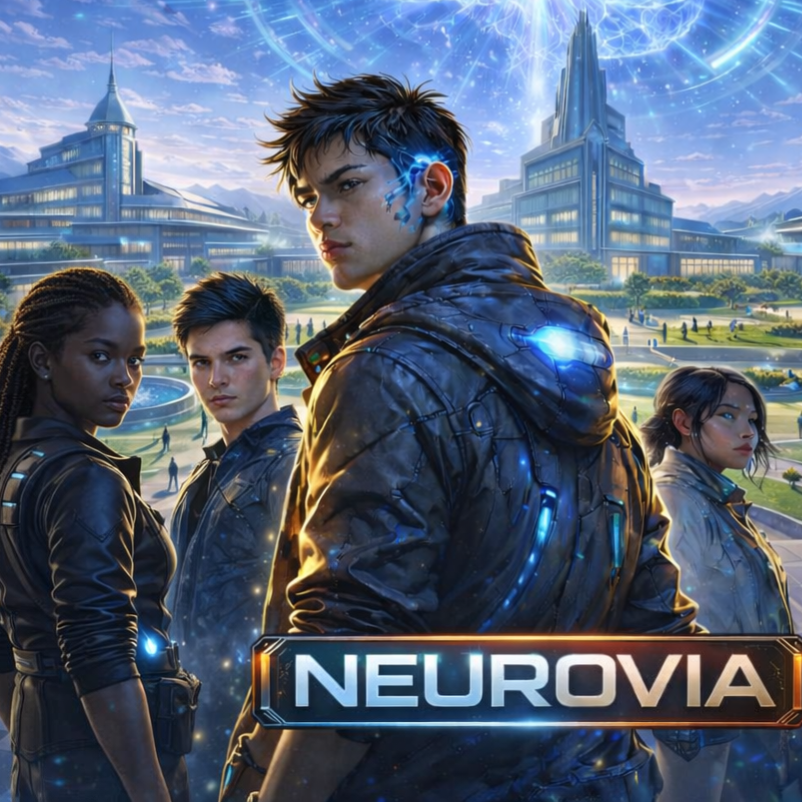
The Neurovia Institute.
The same logo appeared in his glasses, perfectly centered. He hadn’t opened a message. He hadn’t accepted a connection.
He tried to dismiss it.
The logo remained.
CONGRATULATIONS.
You have been selected for Cohort 2 of the Neurovia Institute.
Enrollment includes eligibility for participation in the Catalyst™ Adolescent Integration Trial, pending guardian consent.
He had imagined an acceptance message often enough to know what he was supposed to feel.
For a moment, he felt nothing he could name.
His mother’s fingertips rose to her lips. His father read the message once, then again, his eyes moving more slowly through the second paragraph.
Catalyst.
Julian could hear the word in his own voice, though he wasn’t sure he had said it aloud.
Coffee reached the edge of the counter and fell onto the floor.
His father looked from the logo to Julian.
“¿Qué pasa si decimos que no?”
What happens if we say no?
Julian glanced at the message, searching for a line he hadn’t read yet. A decline option. An explanation for the screens.
“No lo sé, papá.” He swallowed. “Creo que no pasa nada. Creo que solo se van.”
He thought they would simply go away. Hearing himself say it made him less certain.
His mother pulled a dishcloth from the oven handle and laid it over the spill. She kept her eyes on the wall as the fabric darkened beneath her hand.
More text appeared.
Catalyst™: No glasses. No external hardware. Direct neural mediation.
His father leaned forward.
“Eso… ¿es el chip?”
“Not yet,” Julian said. “Just eligibility.”
“What does that mean?” his mother asked.
He read farther down. “Neurological baselines. Adaptive variance. Cognitive resilience. Preliminary screening before trial consent.”
His father waited.
“En español.”
Julian looked away from the display. The terms were familiar; explaining them here, across the kitchen table, was harder.
“They study me first,” he said. “Before anything else.”
His father’s gaze returned to the phrase guardian consent.
His mother crossed to the wall. She touched the silver edge of the logo with two fingertips, lightly, as though testing whether it gave off heat.
“Ellos confían en ti,” she whispered.
They trust you.
Julian wanted to let her have that. He wanted it himself.
Selected. Eligible. Consent. Trial.
He read the words again, trying to find what she had found in them.
Then she turned toward him, and he nodded.
***
That night, Julian stood alone on the narrow concrete balcony off the kitchen. His mother had always promised to fill it with herbs. Two empty pots stood against the wall, one nested inside the other, holding a little dust and the papery remains of something blown in from the street.
Below, the city performed its nightly trick of pretending to be two cities at once.
The real city: sodium streetlights, cracked sidewalks, idling buses, tagged walls, unevenly lit windows.
The rendered city: soft gradient skies, floating civic notices, glowing storefront guides, tidy safety overlays masking anything unsightly.
He took off his glasses.
The second city vanished without a shimmer or fade.
A bus hissed around the corner. Someone two balconies over argued on a phone in a language he didn’t recognize, the vowels round and wounded. A dog barked once, then seemed to reconsider.
The railing was cool beneath his palms. Along its underside, where no one bothered to look, the paint had blistered. He worked one loose edge with his thumb until a flake came away.
Inside, his parents were speaking quietly.
He could not make out the words. He knew his mother’s cadence when she was trying to make a possibility feel practical. His father answered less often. Julian kept his eyes on the street.
He tried to imagine telling his cousins, his classmates, himself. Growing up bilingual had taught him that timing had its own grammar: hesitate and you lost meaning; rush and you missed the point. He caught himself starting in Spanish, switching to English, then stopping before either language could carry him very far.
An opportunity.
A trial.
An escape.
He disliked how easily the last word came.
Below him, a man in a work shirt climbed out of the bus and stood a moment before beginning the walk home. Julian watched him adjust the strap of his bag. He wondered what his father would hear if Julian called Neurovia an escape, and whether explaining would only make it worse.
Behind him, a chair scraped across the kitchen floor.
He put his glasses back on.
The rendered city returned: edges too sharp, skies too generous, rough brick softened, bad lighting turned cinematic. The broken pavement below acquired a smooth path of light showing pedestrians where to walk.
He felt grateful first, then ashamed for feeling grateful, then too tired to know which feeling mattered most.
For another minute he stood between the empty pots and the railing, looking at the improved version of home.
Then he went inside.
***
The drive to Neurovia took forty-seven minutes. Julian counted them.
The road wound through hills draped in morning mist, as though the world hadn’t committed to existing yet. His mother sat with her hands folded in her lap, watching each turn as if she might need to find her way back without directions. His father drove with both hands on the wheel.
Julian couldn’t tell whether he was worried about leaving his son or about the car making a noise it hadn’t made yesterday.
At a bend, something shifted in the trunk. His mother glanced back toward his bag.
He had checked it twice before they left. Now he tried to remember whether his toothbrush was in the outside pocket or beside his clothes. It was easier to think about that than the return drive, when the back seat would be empty.
They crested a hill.
Neurovia emerged from the mist.
Glass ribbons folded against white composite. Terraces opened toward the pale sky, and curved walkways connected buildings set far enough apart to make the empty space seem deliberate. Water lay in a shallow basin beside the entrance, so still that Julian first mistook it for another sheet of glass.
He looked for a fence.
There wasn’t one he could see.
His father eased off the accelerator. His mother exhaled softly.
At the entrance, Julian stepped out into air that smelled of wet stone and cut grass. The car ticked behind him as the engine cooled. He pulled his bag from the trunk and waited while his father checked that it had latched.
Then his AR feed sharpened.
City overlays always required some allowance—a drifting label, a direction marker that slid through a wall, a fraction of a second while an image found the thing it belonged to. Here every line held. Labels occupied exact depths. As he moved his head, nothing dragged behind.
A route appeared across the pavement before he had finished looking for the door.
Julian adjusted his glasses.
For the first time, he felt as though he were the part of the system arriving late.
The entrance opened as they approached.
Inside, students clustered beneath a high glass ceiling, each trying not to seem as though they were observing the rest. Voices stayed low. Sentences died off when a newcomer drew near. A few laughs rose too loudly and ended too soon.
Above every shoulder floated the same tag.
NEUROVIA INSTITUTE — COHORT 2
Cohort 2.
Julian looked farther into the building, toward the corridors branching off the atrium.
There had been a first group. Other students had stood here before them, wearing the same expressions, perhaps reading the same welcome messages. He wondered where they were now.
Near the windows, a girl said, “Catalyst.”
The others around her quieted. Someone glanced toward reception.
Julian lingered apart from the nearest cluster, watching the spaces between people. A girl by the glass angled her shoulders toward the exit. A boy at the desk pretended to read a welcome packet while his eyes moved through the reflections beyond it. Two students who had arrived together now stood several feet apart, each absorbed in something that seemed to require being alone.
He registered these things without deciding what they meant. Bodies gave him information before faces did: who was braced, who wanted more distance, who had noticed him noticing.
His mother’s arms slid around him from behind.
He hadn’t heard her move closer.
For a moment he stiffened, aware of the other students. Then he felt her cheek against his shoulder and let his eyes close. Her sleeve smelled faintly of laundry soap. She was holding him harder than she usually did.
“Trabaja duro,” she whispered. “No olvides quién eres.”
Work hard. Don’t forget who you are.
“I won’t.”
He meant it. He could not imagine what forgetting would involve.
She released him and smoothed the place on his jacket where her hand had caught the fabric. His father stepped forward and clasped his shoulder, briefly and firmly. Julian felt the roughness of his thumb through the collar.
Rafael nodded.
Then they turned toward the exit.
His mother looked back once. His father kept walking, holding the door’s path as though there were something he needed to attend to outside.
Julian watched until the glass closed between them.
For a few seconds he could still see them crossing toward the car. Then the angle of the light caught the doors, and their reflections faded into the grounds beyond.
A banner appeared.
WELCOME, JULIAN REYES.
NEUROLOGICAL BASELINE: RECORDED.
His attention caught on the last word.
Recorded.
He had expected a room. Instructions. Someone asking him to sit still and look at a point of light.
He looked down at the floor beneath his shoes.
Somewhere under the polished surface, a calibration plate had registered his weight shifts, his step rhythm, the tiny adjustments he made before he knew he needed to make them. Sensors sampled the air around him. The building had been gathering what it needed while he watched his parents leave.
Julian knew none of the specifics. He felt only a growing awareness of how exposed he was in the open atrium, with its clear sightlines and nowhere for his eyes to rest unnoticed.
He shifted the bag on his shoulder and began walking.
Somewhere in the west wing, a door closed.
The sound was faint. What caught him was the brief change around it: air touching his cheek, a break in the ventilation hum, the small settling of pressure afterward.
He paused.
His AR offered no label in that direction. No route. The welcome map showed him a lounge, reception, the corridor to the residences. Beyond them, the west wing remained a clean, unmarked shape.
Julian waited for the display to catch up.
It didn’t.
After a moment he followed the bright path toward the dormitories, carrying the sound of the door with him.
Member discussion